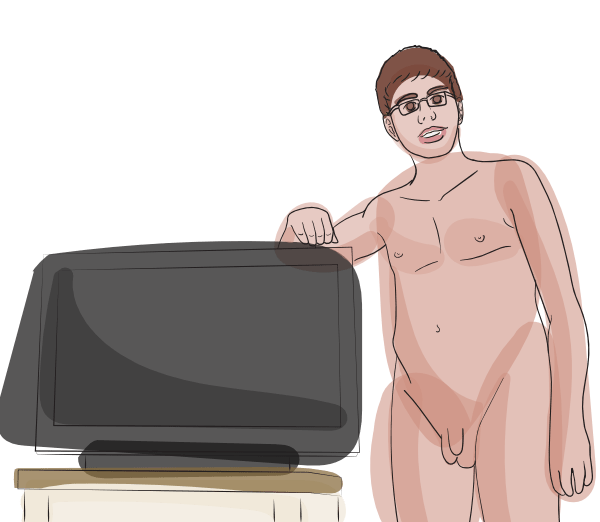
There was a photo of me from 1977, at just under four years old. My brother’s birthday in April that year fell in the midst of a heatwave. We played outside in a tiny plastic pool, my brother and cousins and some kids from the neighbourhood.
I actually remember the day surprisingly well. I went inside and my mother removed my wet bathing suit. Then I insisted on helping bring a tray of cups out.
The photo shows me, nude and smiling, standing at the back door with my tray.
My mother always referred to that photo as “The Dumb-waiter”.
That was my parents’ attitude towards nudity and sexuality all my life: if you couldn’t pretend it didn’t exist, mock and ridicule it. Not in a mean way — they weren’t mean or nasty people — but you knew, as a kid, that nudity wasn’t okay.
But something stayed with me: as I got older, I realized that I got a charge out of being naked. I couldn’t discuss it with anyone; I couldn’t even acknowledge it. But I remember claiming I was sick one day when I was about thirteen, and after everyone had left the house, I showered… and then remained nude for an entire glorious day.
That day remains burned in my mind. But I also knew that nudity was wrong, unacceptable, possibly even sinful. So I hid it, deep down. My teenage years were full of shame and fear, as many teenagers’ are; I learned to associate nudity with sex; and without parental guidance of any kind, I made the unconscious decision to quash my propensity for nudity.
That’s not to say it didn’t bubble up from time to time. In the swimming pool change room, I would linger naked, while at the same time burning with shame; I would sometimes sleep naked, although I kept pajamas nearby in case someone came in unexpectedly.
I worked at a library for a couple of years. I remember distinctly seeing a feature article in a magazine about a nudist resort not far from me; it even had a couple of photos of nude women, including one of an older woman playing badminton — with breasts exposed. Of course as a fifteen-year-old boy, the picture of breasts grabbed my attention pretty easily. But the thought of people being nude and playing badminton was not only titillating, it was intriguing. People really did that? Just outside the city where I lived?
But again, I suppressed it. I had never seen a nude woman in real life; there was no internet, and pornography was difficult to find.
But my fascination with nudity stayed. The idea of going to a nude beach still lingered in the back of my mind. And then one day, by chance — sort of, I was probably surfing for porn — I came across a real nudist site.
That got me thinking. There were still nudist resorts in my area, weren’t they? There were probably other nudists, too. I could even… try it out.
I joined some message boards, read everything the nudists out there had to say. Asked about the places in my area. And waited for the opportunity.
 I waited for about two years before I was ready. Then on a beautiful July Saturday, I drove an hour to a nude beach on the shore of Lake Erie. I followed the directions I printed out from online: drive to the provincial park and pay for parking; go to lot number five, furthest from the gate. Walk out to the beach, turn right, and follow it until you reach the end of the park.
I got to the markers, about five minutes’ stroll from the lot. I could see people in the distance, but no one was close enough to see clearly. Were they nude? Was it real?
And what was I supposed to do? Was I supposed to take my clothes off here, or should I wait until I found a place to lay out my towel and sit? No, surely not. There weren’t that many people on the beach. I could find a spot first.
But I passed a couple of knots of other beachgoers, and started feeling out of place. I was only glancing out of the corner of my eye, not wanting to stare, and they were nude. Most of them were nestled up in the driftwood and bushes near the top of the beach, but there’s something about nude bodies. You can just tell.
So I stopped at a large, sun-bleached log and put my bag down. My breath was shorter and shorter, my head spinning with what I was about to do.
I undid my shorts.
Pulled them down, stepped out of them.
It was like slipping into a bath, the warm breeze from the lake enveloping me, touching skin that had not felt sunlight in many, many years. In seconds my shirt followed.
And I was nude.
I walked to a clear spot, put my towel out, lay down, and felt the sun fall on me.
I was a nudist now, and would never again be anything else.
Journalism about nudists is terrible.
Newspapers and websites love nudism. The nudity taboo is so strong in our society that anything involving naked people is a reader magnet. Journalists play straight into this narrative with articles that are designed to tap into readers’ naughty thrills.
The result: terrible writing about nudists and nudism. Articles treat nudists like an alien species, or like a gang of lunatics ostracized in “colonies”. They use childish jokes, unfunny references to body parts, and the most tired cliches imaginable. How often does an article promise the “bare facts” about nudism?
As nudists, we can we can start to influence how nudist topics are covered. Society is probably not going to start to respect, or even accept, nudists any time soon. But we can take positive, constructive action to shift the standard narrative away from its childish, sniggering shamefulness, and towards a positive, accepting view of nudism.
Here are some actions we can take any time we encounter poor coverage of nudists in the news.
Wherever we respond, though, attitude is crucial to getting our message across. The general public already believes the narrative about nudists being slightly deranged, out of touch with social norms, and oversexed or perverted. It’s extremely damaging to nudists to play into this narrative.
A common mistake is to try to turn others into nudists. You won’t convert anyone; you’re likely to come off as a weird crank who wants to see other people naked. Don’t say “If you only tried it...” Leave non-nudists out of it.
And do not escalate the dispute. Accusatory language (“How dare you!”), victimhood (“We’re being persecuted!”), and anger (“You fool!”) will all weaken your argument.
Instead, concentrate on the positive nature of nudist philosophy. Less shame, more body positivity. People from all walks of life enjoy nudism. We’re not harming anyone. We welcome an opportunity to discuss our values.
One of the benefits of the nudist culture is the exceptionally friendly individuals involved in the lifestyle promoting well-being and healthy life choices.
This is a great message to put out into the world! Incorporate those positive values as much as you can when you call out poor coverage of nudism.
The search for acceptance of nudism in our nudity-averse society is an uphill battle. If all nudists become active, positive advocates for the nudist philosophy, though, we can’t fail to improve others’ attitudes as well, even if they choose not to take part in the lifestyle themselves.
Have you found any examples of good journalism about nudism? Post links in the comments below!
Whether or not you’re a fully committed nudist, joining a nudist group is a good idea. The benefits usually far outweigh the small membership fee.
The first objection that many people have to joining a nudist group is that they can get the same thing for free online. This might be true for some organizations, but it definitely isn’t true for nudist organizations. There are some legitimate online nudist organizations, but they are far outnumbered by illegitimate ones.
Why are so many groups illegitimate? It’s the voyeuristic quality of the internet, unfortunately. When people discover that nudists are posting photos of themselves, the membership quickly explodes with people seeking nude photos. (With the number of nude photos available on the internet already, it’s hard to understand why they do this, but it seems inevitable.)
There are some online organizations that do not require or even allow photos. These sometimes start up really well, but they present another problem: authenticity. There’s no way to know whether a profile represents an actual nudist. Too often, profiles on these sites are just people looking for female nudists to pester for photos, or someone satisfying other, more prurient interests.
It’s far less common for people to join legitimate, established organizations if they aren’t already a nudist. So if you want to be sure you’re part of a group with actual nudists as members, and supporting real nudist values, join an organization that isn’t just online.
Supporting these groups is a small step towards bigger changes we need to make nudism more acceptable in our society.. As the groups gain members, their political clout and public reach increase. Societal change is slow and incremental, but you can help to speed things up by joining an organization. (You can help even more if you’re able to contribute as a volunteer, too.)
One of the most important benefits to joining an organization is information. You’ll hear about issues involving nudism, issues that you might be able to help with (such as by signing a petition). You’ll learn of new nudist groups and venues, or even established venues that you didn’t even know about. But the biggest benefit is getting to know the people who are making nudism a reality. It might feel like a small thing, but so often we say “If only I had known...” This is one way to make sure you’ll know what’s happening, when it happens.
Finally, becoming a member of an established organization helps to legitimize and normalize naturism, not only in general, but for you. By becoming a member you are making a commitment to nudism, and that will have an effect on your own engagement and involvement with the nudist lifestyle.
What organizations are in your region or country, and have you considered joining them? What would you want to get out of a membership in a nudist organization? Tell me in the comments - and post some actions you’d like to see nudist groups take, if you have any ideas!